Concepts
Who Is Vouching for You?
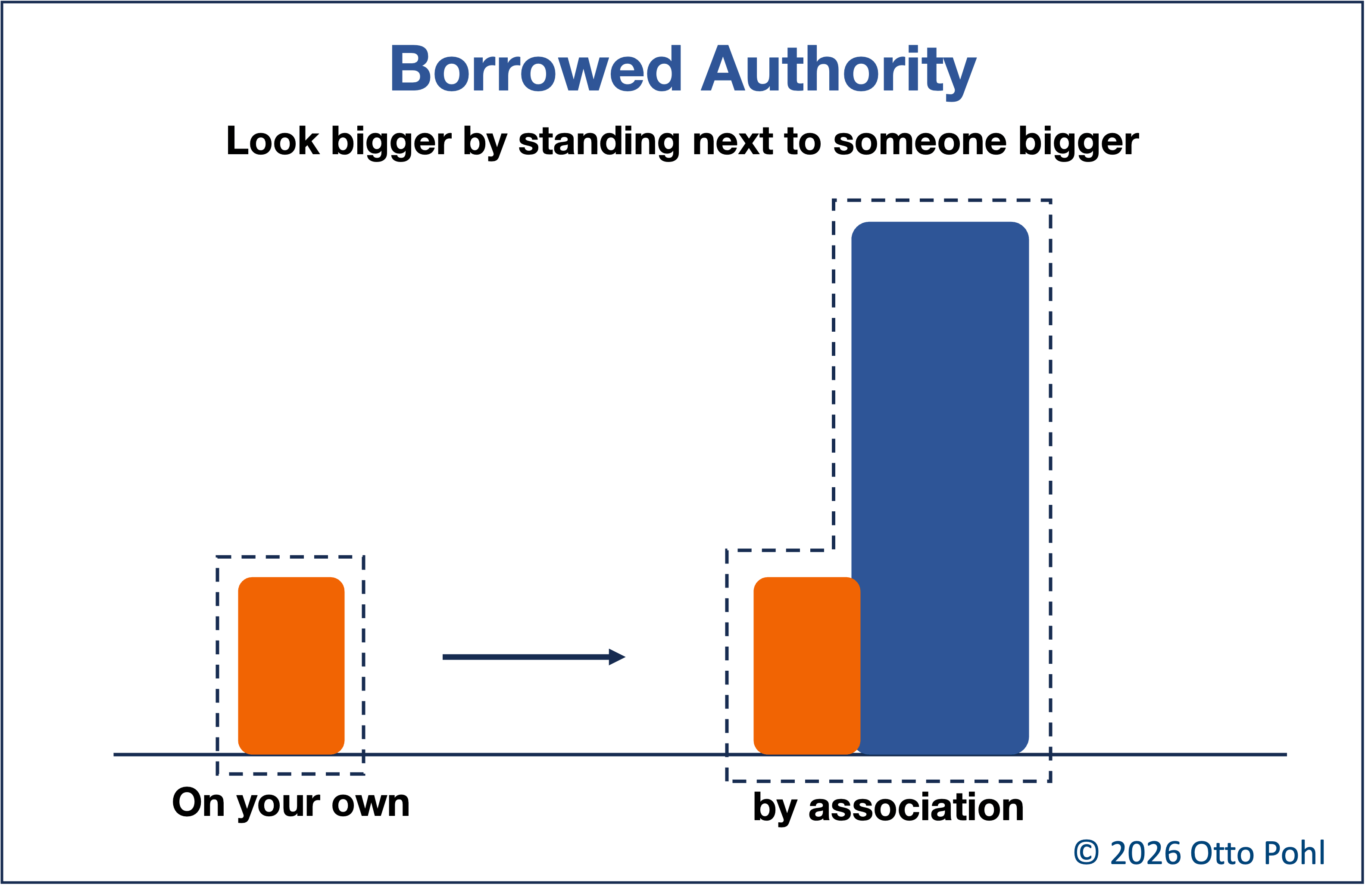
Let's go beyond social proof and talk about all the ways in which your startup can look bigger by associating yourself with larger and more successful entities.
Otto Pohl
Share this post

As any client or webinar attendee knows, I’m a big fan of social proof. Customer quotes, reviews, or investor logos are all examples of ways to provide external validation. It’s always better to have others saying (or implying) that you’re great instead of you saying it.
In recent weeks I’ve seen three types of credibility by association that expand this concept of social proof. Are you playing all your strongest cards?
Institutional Gravitas
A few weeks ago I spoke with a fintech founder with the contrarian thesis that alternative data like phone records, utility payments, and app usage can produce more accurate credit decisions for most developing nation consumers rather than relying on standard FICO-style models.
The founder was convincing, but the argument and data he presented was his. It left room for reasonable doubt: does credit really work that way? Then a friend forwarded him a World Bank report that laid out exactly the argument the founder had been making, carefully researched and footnoted.
When integrated into the fintech pitch, the argument was suddenly grounded by World Bank gravitas. Contrarian became savvy.
Note: Citing reports doesn’t replace your own work. Just as when referring to research to validate something like market sizing, it’s important that you bring your own experience and logic to bear first, and then validate it with the report.
Time Travel
Every time an investor says to you, “I like what you’re doing but want to see more traction first,” what they’re telling you is that they would like to know how the book ends before spending time reading the first page.
So give them that. Well, not literally, but if you can make the plausible case that you’re just like an analogous company that’s further along, you can hitch your wagon to their success.
This is a particularly powerful tool for deep tech and biotech companies, since those industries depend on a conveyor belt of breakthroughs to move forward. Previous successes of companies in the same category aren’t competition; they’re validation.
I was working with a medical device startup with a new tool that shortened the time a physician needed for orthoscopic surgery. We found several companies that had built other tools for the operating room that had exited for hundreds of millions.
Suddenly, the founder could show investors a lighted path towards multiplying their money; a Series A quickly followed.
(For a broader take on this concept, read my previous post, Analogies Are Copy-Paste for the Mind).
Categorical Success
A recent EU report about a Munich-based semiconductor industry client of mine described them as potentially “Europe's next ASML.” (ASML is an iconic European semiconductor success story with a virtual monopoly on the lithography required to make high-end chips; their market cap is well north of $600B.)
We use this comparison whenever we can. It’s even better because someone else said it, of course, but the category comparison can be powerful even if you have to do the comparing.
There is similarity to my startup analogy recommendation above, but here you’re not citing other startups a few steps ahead of you on the conveyor belt of growth; you’re picking a non-competitive leader in the same field.
The key is that you position next to an incumbent, slipstreaming behind their legitimacy without challenging their territory.
If you are positioning against an incumbent, check out my article The Carob Problem on how to best do that. Also, the comparison must be defensible. “We're the next ASML” sounds great until an investor asks how you're like ASML and you can't answer. Pick analogies the way you pick stinging nettles—carefully.
Living on Borrowed Authority
Take another look at your pitch deck. Are you making the most of your extended social proof? Investors don't owe you the benefit of the doubt. But they'll extend it to McKinsey, a startup with a 100x exit, and today’s category leaders.
Scour your horizon for sources of reflected strength. Put them in your deck. Living on borrowed time is not great. Living on borrowed authority? Beautiful.
Share this post
Otto Pohl is a communications consultant who helps startups tell their story better. He works with deep tech, health tech, and climate tech leaders looking to create profound impact with customers, partners, and investors. He has taught entrepreneurial storytelling at USC Annenberg and at accelerators across the country.