Concepts
The Unbearable Lightness of Startup Planning
It's so hard to make projections about the future of your business. Yet that's what everyone wants to hear. Here's how--and why--to do it, even if you know your forecasts are wrong.
Otto Pohl
Share this post

I’m working with a life sciences founder who speaks passionately about the science of hematology but goes wobbly when it comes to sales and growth forecasts. The back half of his first pitch deck was full of internet-sourced TAMs and vague growth targets. It wasn’t a vision; it felt like a shrug.
I understand the fear of forecasting, particularly from academic founders. The scientific method is built around an iron-clad rule: you don't assert what you can't prove. You speak from data, not a soapbox.
So how—and why—should you make projections, particularly when they’re wrong approximately 100% of the time?
It’s a problem that’s acute for academics and a risk for everyone. Most of us tend to push from yesterday instead of pulling from tomorrow.
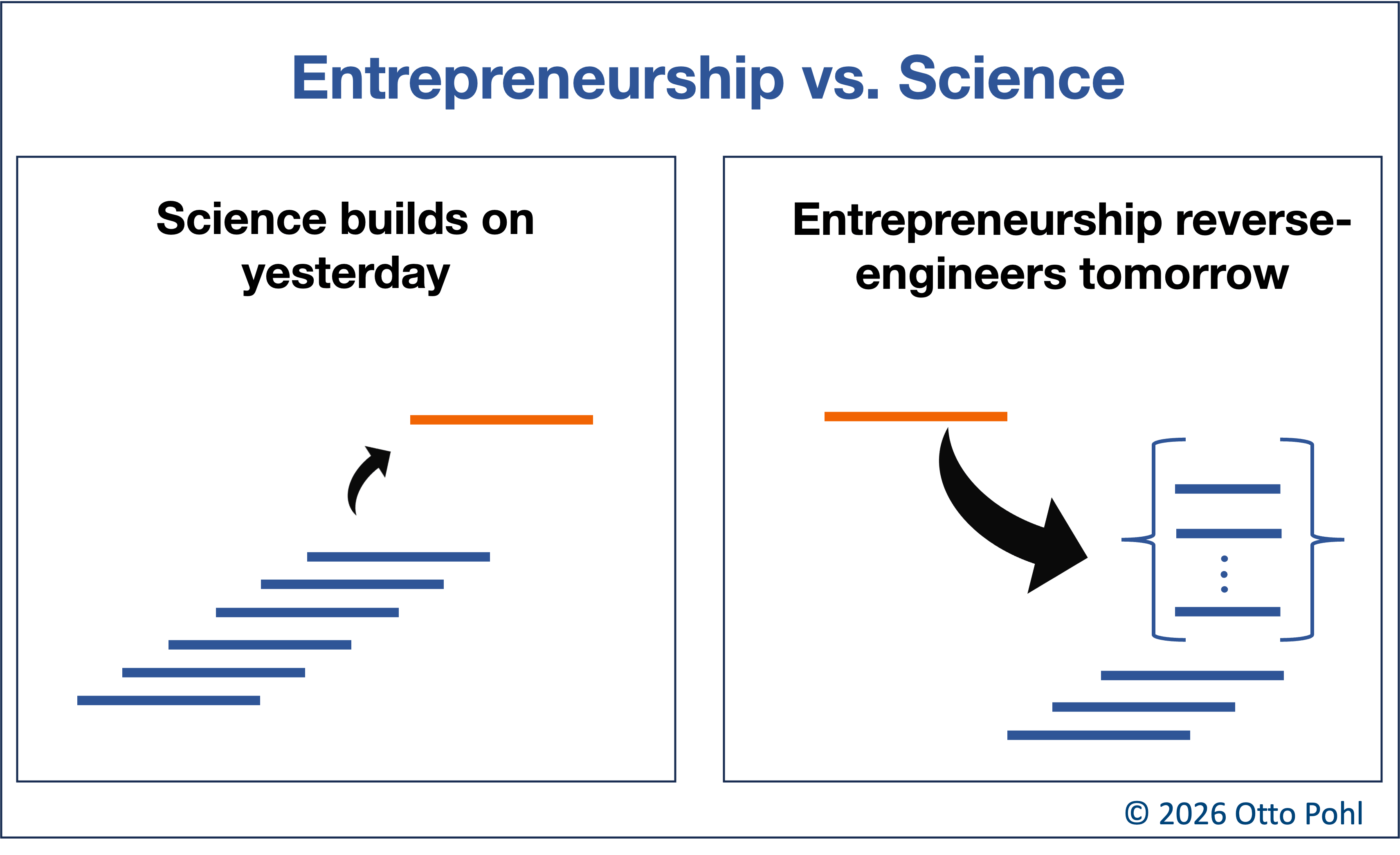
Here’s the thing: What you say about your company’s future offers your audience x-ray vision into how you think and how you’ll execute. Your words describe what you see standing between you and success (those items shown in the brackets).
The shift from push to pull has both mindset and communications aspects. And it requires a comfort with the existential absurdity of startup forecasting.
Plans Are Useless
As President Eisenhower loved to say: “Plans are worthless, but planning is everything.”
Mr. D-Day nicely captures the central paradox of early-stage entrepreneurship. Your projections are wrong. Your revenue line is off target. Your timeline is delusional. And yet: the process is valuable anyway. Because the value isn't in the plan — it's in what the plan forces you to think through.
Spend the time, and you’ll have working reasoning to questions like: Why do you believe you will start sales in Q3 2026? How will you get 2 partnerships by EOY? What needs to happen for revenue to grow as described? Even if (when) the numbers are proven wrong, the process illuminates your approach and assumptions. And you’ll have something to measure reality against.
Reshaping Your Mindset
Here's what unlocked it for my founder: We stopped talking about predictions and started discussing hypotheses. Specifically, we made a list of the falsifiable assumptions on which his forecasts depended.
Having clarity on what needed to be true for the forecast to hold was something his scientific training could respect. We went from "We're going to hit $1m in year 2,” to “we plan to hit $1m in sales based on the following three things.”
That framing also made clear the KPIs he needed to track. If reality doesn’t match your assumptions, you need to adapt your hypotheses.
Communicating Investor Updates
Everyone loves to say they are “data-driven.” But as friend-of-the-newsletter Cassie Kozyrkov, the former Chief Decision Scientist at Google, never tires of saying, data-driven means deciding before you learn the data what numbers would drive what decision. You’re not data-driven if you wait for the Q3 sales numbers to decide whether to change course.
Regulator investor updates (you are sending those, right?) are the perfect venue for updating your forecasts/hypotheses. The investor update is one of the rare communications formats where showing updated thinking — where you were wrong, what you learned, what you changed — actually builds credibility rather than eroding it.
This approach makes your updates genuinely useful rather than cheerleading. Second, and more importantly, it gives you the language for a pivot that doesn't feel like a retreat. You're not abandoning the plan. You're reporting that assumption B didn't hold, so here's how the model evolves.
Two Traps to Avoid
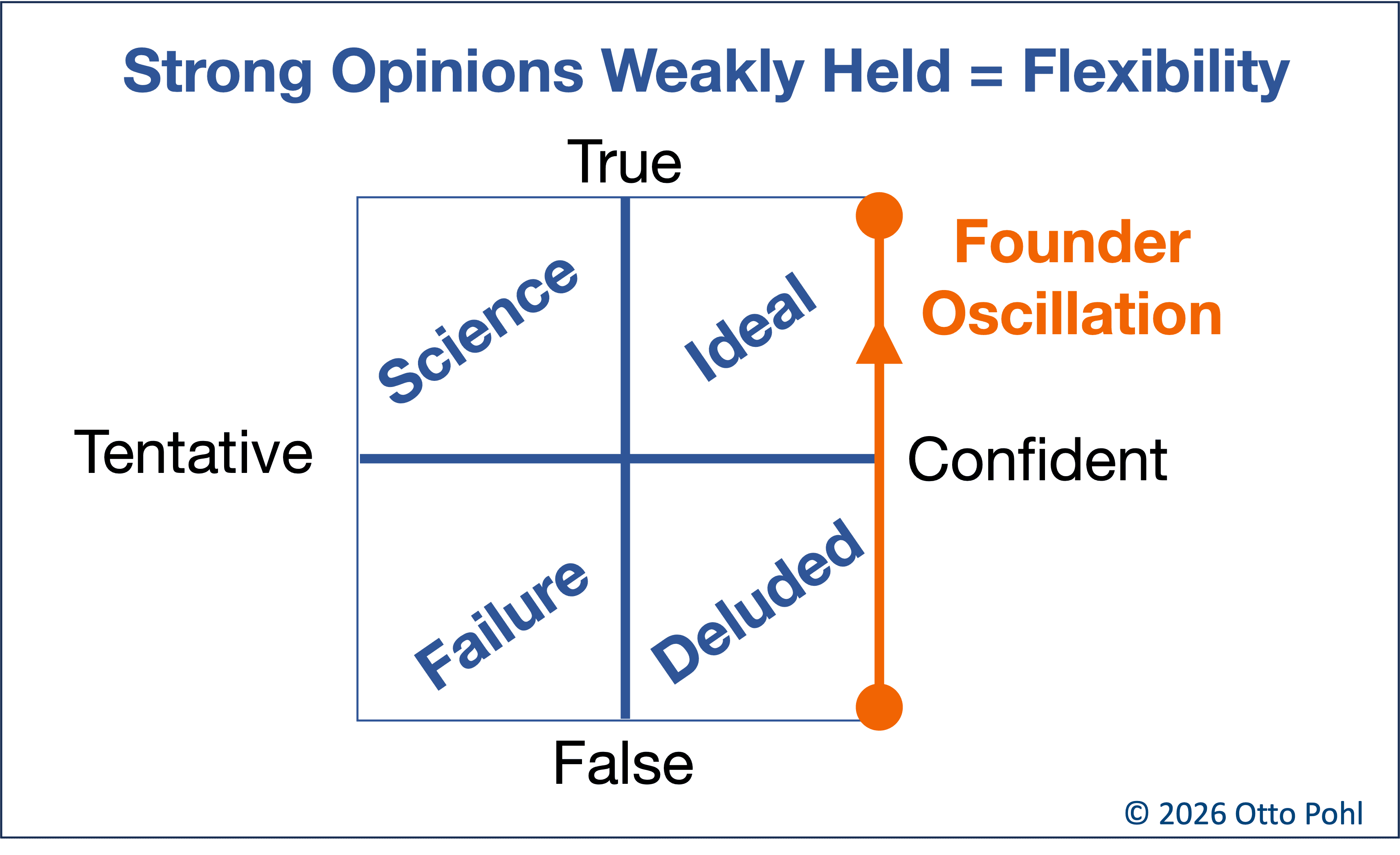
The story you tell becomes the story you believe. As a founder, I fell into this one. Your your job as a CEO is to keep telling a clear story over and over again. But there’s a real risk that you’ll continue telling that story as contradicting evidence accumulates. I call it “breathing your own exhaust.”
The pre-emptive pivot. I’ve over-corrected from Trap 1 right into this one: every time someone tells you that what you’re doing is impossible or suggests a “better” approach, you leap to that. Pivoting can be a sophisticated form of cowardice — a way of outsourcing conviction to the last person you spoke to.
The challenge is that you need to project 100% confidence in your projections while maintaining the openness and intellectual flexibility to turn on a dime when reality intrudes. It’s what Adam Grant calls “strong opinions weakly held.”
Ignore the Reality Distorters
It’s a bit of a disservice to founders that some of the most admired founders are reality distortion experts. Steve Jobs at Apple was able to bend history toward his vision instead of adapting his vision to external reality. Elon Musk has had his moments as well. The fact is that that requires a rare confluence of talent, technological trends, and luck. More frequently, the entrepreneur is a market taker, not market maker.
Instead, a founder needs to hammer the same ideas and vision day in and day out without becoming blind to changing realities. There’s a fine line between perseverance and obstinacy.
Conclusion
Take a minute now to look at your forecasts: are they based on concrete assumptions, or are they merely based on an intellectual shortcut (“All we need is to capture 1% of the market!”)?
Reality will write the story of your business. The plan you make provides the vocabulary. Got some language you’d like to talk through?
Share this post
Otto Pohl is a communications consultant who helps startups tell their story better. He works with deep tech, health tech, and climate tech leaders looking to create profound impact with customers, partners, and investors. He has taught entrepreneurial storytelling at USC Annenberg and at accelerators across the country.