Pitching
What's Your Moat in an AI World?
AI has accelerated our world. When someone can vibe code almost anything over a weekend, what's going to give your company a defensible moat? A look at what works.
Otto Pohl
Share this post
A few weeks ago, Anthropic announced Mythos, an AI tool that supposedly has extraordinary hacking powers. And just like that, investors questioned the existence of a cybersecurity startup I’m working with.
A few days later Anthropic launched Claude Design, and everyone asked aloud whether Lovable, which had tripled its valuation to $6.6b just in December, is doomed to irrelevancy.
Tech companies feel more ephemeral than ever. AI seems to churn everything into a blur.
So—how do you defend your business amid a shifting technology landscape? What makes your great idea a sustainably great business? You can’t tell a great story until you have solid answers.
First, the cause of the crisis: In recent decades, developing software was fast, but not too fast. Easy, but not too easy. Being first and fastest into a market offered a durable competitive advantage, and there was zero marginal cost to scale. The wonderful SaaS business model let you reap rewards year after year.
Suddenly, software is like a treadmill that went from a comfortable jog to spinning so fast it takes your legs right out.
To be less dramatic about it, we may be returning to a world of normal company building, where software is relegated to the same status as other tools. In other words, use the treadmill, but don’t put your weight on it.
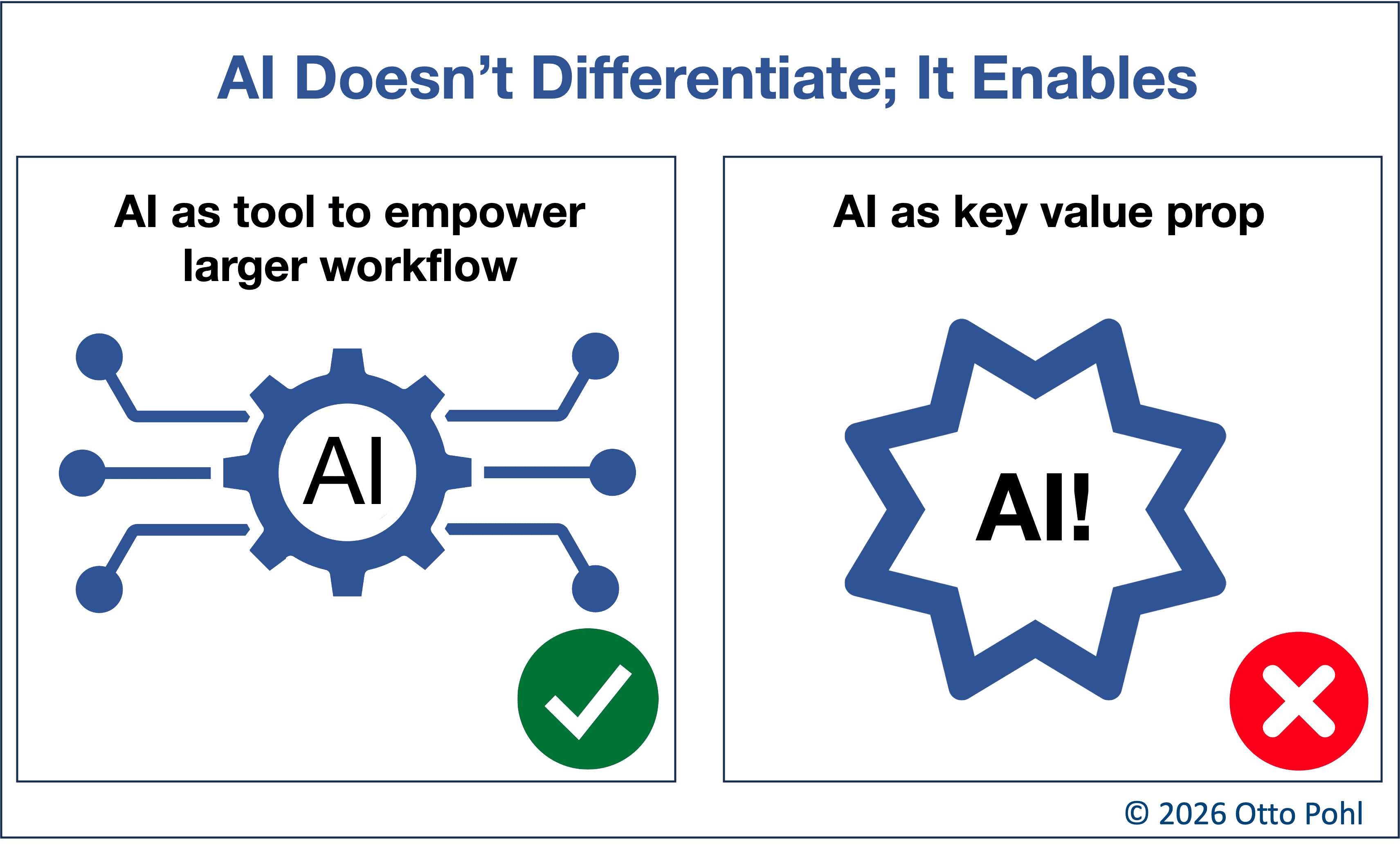
As pure software moats weaken, defensibility increasingly comes from things AI cannot easily replicate: humans (relationships, trust, taste), regulated environments (compliance, licenses), proprietary signal (data only your product generates, or has access to), deep workflow integration (your customer can’t imagine life without you), and physical reality (logistics, hardware integration, real-world processes).
To be clear, moats don’t create great businesses; they protect great businesses. So step 1 is to make sure you have a valuable idea. Then you figure out how to guard it from being economically pillaged the moment it proves its worth.
Offering generalized advice is hard. Instead, let me share some startups I’ve seen recently with strong narratives around defensibility.
Network Effects Create a Proprietary Dataset Flywheel
How does Budweiser know if the Yankees are offering them a good deal on a stadium marketing deal? (Or inversely, how do the Yankees know how to make a fair offer?) Sports sponsorship is a huge and hugely opaque market. This startup built a service to evaluate proposals using AI. Upload the proposal to get the evaluation. As enough people use it, the startup becomes uniquely knowledgeable about the market, and their tool keeps getting more valuable. Boom—Bloomberg for sports sponsorship.
Unique Input Dataset Creates Valuable, Defensible Tool
Congestive heart failure is deadly to have and expensive to treat. Fluid builds up in the patient, often for weeks, until the heart gives up. If it’s detected early enough, diuretics are remarkably effective at eliminating the fluid and the risk. But detection—that’s hard. This startup I worked with realized that the fluid that accumulates in the lungs affects your voice. And they have exclusive access to the data from a research lab that has been recording the voices and patient outcomes of patients at risk of CHF for many years. That’s a difficult and time-consuming dataset to create—but if you have it, you can build an app that listens to at-risk patients for a few seconds a day to determine with remarkable accuracy whether they’re at risk of CHF.
Process Power & Supply Chain Integration
Using AI to discover novel molecules and materials isn’t a differentiator. The discovery is the easy part — and getting easier every quarter. A drug-discovery startup I’ve watched up close uses AI to generate candidate molecules for a hard-to-drug class of protein targets. Their model is genuinely good, but the founder downplays it. He’ll talk about the contract manufacturer who, after eighteen months of relationship-building, reserved capacity for their unusual synthesis route. He’ll talk about the assay protocols his team co-developed with two academic labs to validate hits faster than competitors. He’ll talk about the data-sharing agreement with a hospital system that gives them outcome data no model can synthesize. None of that is sexy, but also none of it can be replicated by a competitor who trains a better model next quarter.
Good Technology, Industry Partnerships, Relentless Execution
Many deeptech businesses have an AI software component but are built on classic IP. I’m working with a company that has a powerfully better way to test for molecules at the parts-per-billion range. That’s valuable for industries including agriculture, food production, perfumes, and forensics. The founder is copying the playbook that worked for the current dominant technology: partnerships with marquee labs, industry partners, and regulators. The digital tools that accompany his technology make his offering more attractive, but the only way to replace the incumbent is to build one partnership at a time until the status quo suddenly shifts in his favor.
Classic Network Effects
It’s too early to tell if Boardy will be a powerful long-term business or this year’s Clubhouse. So far I’m impressed. Boardy is an AI superconnector. Starting with a remarkably natural-language intake call with Boardy’s Australian voice, Boardy knows who you are and what you need and then makes mutually-agreed introductions. It started to connect founders and investors but has quickly broadened out as a broader introduction tool. I’ve met some great people through it. It’s a classic network effects business. Can it stay effective, or will the noise swamp the network value? In any case, the crucial fact is that its success, and staying power, does not depend on having the best software.
My kingdom for a moat / a moat for my kingdom
My crystal ball has proven fairly faulty in the past, but I think that the most powerful AI moat will be custom data. We are sadly not far away from the time when parents can strap a recording device to their newborns so their AI can see and hear everything that child ever experiences. That would offer substantial benefits, along with a real dystopian nightmare.
Already, we're exposing more and more of our data to AI (Zoom transcripts, email, browser history). As that user history accumulates, the idea of walking away from it—or suffering through a messy data migration—becomes unbearable. The ultimate moat may not belong to the company; it may belong to the customer.
Working on figuring out how to build—and talk about—a defensible business in an AI world? Let’s chat.
Share this post
Otto Pohl is a communications consultant who helps startups tell their story better. He works with deep tech, health tech, and climate tech leaders looking to create profound impact with customers, partners, and investors. He has taught entrepreneurial storytelling at USC Annenberg and at accelerators across the country.