Pitching
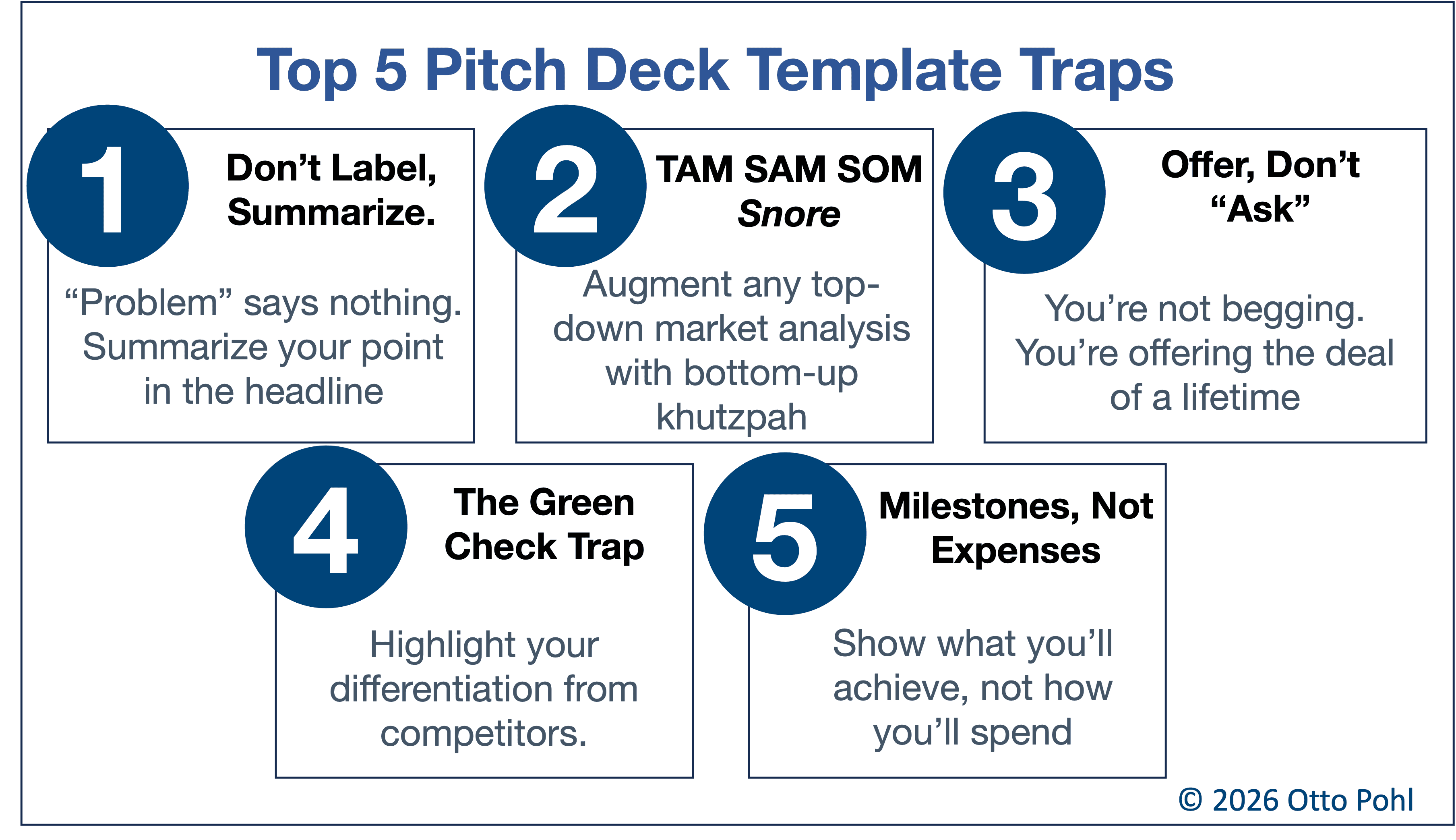
Top 5 Pitch Deck Template Traps Killing Your Raise
Pitch decks are like haiku. Constraints create power. But using a paint-by-numbers approach to fill in a pitch deck template online not only means you'll miss the opportunity to truly create something special, but you'll likely make a bunch of mistakes. Here are the worst 5.
Otto Pohl
Share this post

There are a million pitch deck templates online. They’re not inherently bad. But if you treat them as a paint-by-numbers shortcut, you’ll miss the opportunity to highlight what’s truly special about your company.
That’s why I’ve written about a better pitch approach and a narrative framework of deck structure.
More insidiously, these templates promote and propagate mistakes I see time and again. Let’s stamp them out once and for all.
Placeholder Headlines
Templates label slides with category names: "Problem," "Solution," "Team," "Market." And founders keep them. Big mistake. It’s like naming your book “Title.”
The headline is the largest text on your page. Use it to tell the audience what you want them to believe.
Not: "Problem"
Instead: "85% of Clinical Trial Data Is Entered Manually—Costing $2.4B/Year in Errors."
The rest of the page should be dedicated to proving that point.
Every slide you create (and not just pitch decks!) should follow this rule: The headline makes an argument. The body proves it.
When you finish your deck, you should be able to flip through reading only the headlines and understand the key points.
If that doesn’t work, your narrative isn’t clear enough yet.
TAM SAM SOM Trap
I’ve come to dread this slide. Not because the framework is wrong — it’s the laziness it enables:
Google your industry’s total revenue. Copy-paste for your TAM.
Find a somewhat relevant subset. That’s your SAM.
Do the “if we only capture 2%” calculation for your SOM.
This tells investors nothing about the only question that matters: how exactly are you going to win?
Which customers will you target first? What’s your wedge? How do you expand from there? The concentric circles of TAM SAM SOM answer none of these questions.
Even worse, the “only 2%” math is quietly self-defeating. If your product is truly transformative, why would you only win 2%? And if it’s not, why should anyone invest?
There’s some 30k-foot-value to the top-down calculation, but pair it with a bottom-up analysis built around a strategic market entry plan that includes revenue & market size numbers: What makes you a slam dunk for your beachhead segment, the size of adjacent markets you’ll target next, and why every step unlocks even more opportunity.
Never, Ever, “Ask” for Money
Nearly every template labels the fundraising slide "The Ask." Language shapes posture, and "Ask" frames you as a supplicant. You’re asking the investor for a favor.
It’s a generic headline that’s in a category by itself because it undermines your negotiating position.
If you truly believe your company is going to be worth a billion dollars—and you believe that, or why are you raising venture capital?—then offering a big chunk of your company for pennies on the dollar is the deal of a lifetime. The investor should be thanking you.
At the very least, label the slide “The Opportunity.” Better yet, use the headline to highlight the value you’ll create using the money you raise.
The Green Checkmark Trap
You’ve seen this slide a hundred times: your product in the left column, competitors across the top, your column the only one that’s a wall of green checkmarks. Four problems:
It implies incremental improvement. A few extra checkmarks isn’t a 10x breakthrough.
It flattens importance. Your core innovation visually weighs the same as “has mobile app.”
It’s boring. Of course you’re all green and the others suck—you made the slide!
It’s apples to oranges. You’re comparing your roadmap to competitors’ shipped features.
The competition slide is a tough one to make a one-size-fits-all recommendation because of the variation among industries and business models. But keep this in mind: your goal isn’t to show you’re check-the-box better. Your goal is to show you’re playing a different game. Often a 2x2 matrix can be a good way to show you in the magic upper-right quadrant when measured on two key variables. Maybe augment that with something industry-specific. Maybe there’s a category-creation slide. In any case, green checkmarks won’t capture your profound differentiation.
Spending Is Easy. Buying Is Hard.
Many templates add a “use of funds” component to their Ask slide. Imagine a general presenting his war plan: “I’ll spend 40% on infantry, 30% on artillery, and 30% on logistics.” You’d fire him. What battles will he win?
Same principle. What matters isn’t how you’ll spend the money—it’s what you’ll buy with it.
Think of your company’s potential value as a billion-dollar balloon currently crushed by risk and uncertainty. Your job is to show how you’ll strategically eliminate those unknowns, letting your value inflate to its rightful size.
If the milestones you plan to reach justify a 3-10x valuation increase by the next round, you’ll get investor attention.
The Bottom Line: Start with the Story
Templates are scaffolding, not architecture. Don’t let the insidious mistakes inside that scaffolding undermine you. Focus on the story, and the slides almost build themselves.
And if your deck still feels “meh” after all that? Give me a shout.
Share this post
Otto Pohl is a communications consultant who helps startups tell their story better. He works with deep tech, health tech, and climate tech leaders looking to create profound impact with customers, partners, and investors. He has taught entrepreneurial storytelling at USC Annenberg and at accelerators across the country.