Concepts
Nobody's Confused About What You Did
Successfully applying for a job is just like finding customers for your startup. Here's my narrative playbook, adapted for job seekers
Otto Pohl
Share this post

I had coffee yesterday with an engineer friend. His company recently went from ‘startup’ to ‘stopdown.’ He needs the next big thing.
Startups fail, so I have this conversation relatively regularly. I’ve come to realize that a career transition is an analogous pivot/positioning challenge to developing a narrative for a startup. The average open role now draws over 300 applicants, roughly triple 2021. Landing that job with those numbers is like closing a seed round on the first pitch.
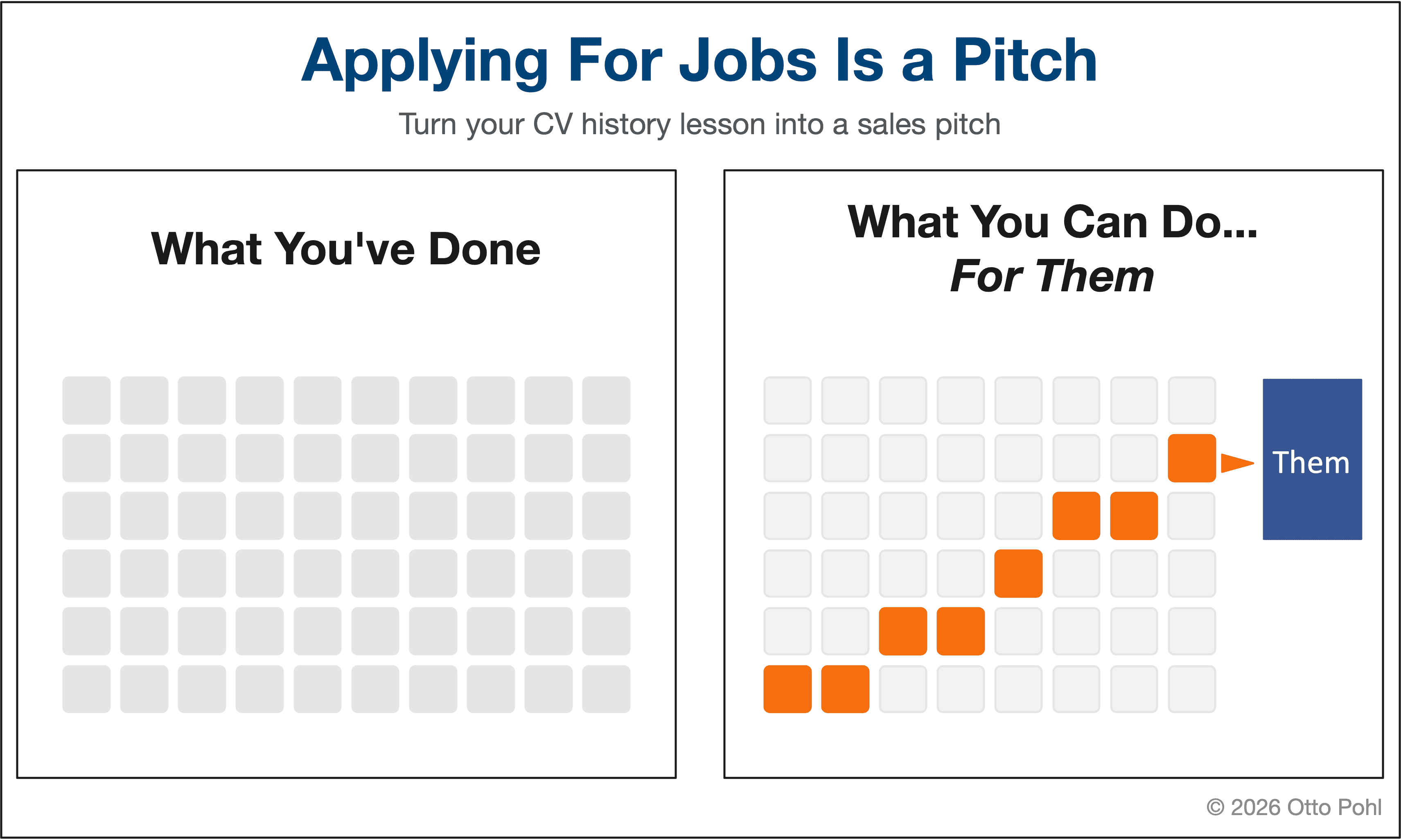
A key aspect of my work with startups is to make sure they’re being explicit about the value their product or service creates for their customers. The product features themselves are merely proof points and stepping stones on the path to that value creation. Analogously, the items on your resume are just a list of product features until you position them as the collective preamble to all the value you’re about to create for your next employer.
No one is confused about what you’ve done. Everyone wants to know what you’ll do for them.
If you or someone you know is looking for something new, here’s my advice:
Build a thesis about where the world is going and where that creates opportunity.
Before you position yourself as who or what you are, go find out what's happening. Where is opportunity emerging? My friend is seeing that smaller companies, ones that were happy with standardized off-the-shelf software, now need customized AI workflows. Companies that serve that opportunity are going to have huge growth, and they’re going to need AI engineers.
Find where that thesis overlaps with what you're honestly better at than most people.
For my friend, that trend opens a clear opportunity for his engineering background. You need one valuable thing you're naturally better at than most people, which is harder than it sounds, because our education system trains us toward well-roundedness. A ‘C’ in biology? Better work harder on biology. The real answer is: don't do biology. This step is startup Story Market Fit applied to yourself. Remember, a good narrative can merely highlight what already is plausibly true; it can’t conjure results from nothing.
Define yourself precisely into that overlap, narrowly enough that it feels uncomfortable.
“I’m an engineer and can build AI workflows” is way too vague. Just like Clay floundered when its pitch was that they let customers “Build tools & workflows to supercharge your team” (what’s that mean?) and exploded when they laser-focused on the value they created for go-to-market teams, you need to position yourself as a very specific solution for a very specific problem. That might repel some potential employers, but the ones that have that need will snap to attention.
Build a narrative that makes your background look like you were destined for this opportunity the whole time.
Now that you know where you want the story to end, highlight everything in your background that adds. Cut everything else. I’ve done a bunch of things in my career I never talk about anymore, since they don’t add to where I am today. Michelangelo wrote that a block of marble already contains every figure the artist could imagine. To find the David that matches your market thesis, chisel everything else away.
Network and apply to companies working in that space.
Referrals are roughly 7% of applicants and somewhere between 30% and 50% of hires. Some of that is selection, since referred people tend to be better matches to start with, but it's still your biggest point of leverage. Here's the part people miss. Step one gives you a reason to call strangers that isn't "please hire me." You're not asking for a job. You're reporting. And the difference between those two calls is the difference between someone dodging you and someone spending forty minutes explaining their industry to you.
Three headlines, before and after:
Conventional: Senior Software Engineer | Distributed Systems | Python, Go, Kubernetes
Better: I build the data infrastructure that gets lab instruments talking to each other. Ten years in distributed systems, four of them in regulated environments.
Conventional: Ph.D. chemist with experience across analytical, process, and formulation.
Better: I take assays that work on a bench and make them survive a manufacturing floor.
Conventional: Operations leader | Scaling | Cross-functional collaboration
Better: I've taken two hardware companies from twelve units a month to twelve hundred. It's the only thing I do.
Open your LinkedIn headline right now. If it would work just as well for every other applicant, that's not a position, it’s a category label.
My friend can list every job he's held and still can't describe the line running through them. Which is exactly the founder who can describe her technology in flawless detail and goes quiet when I ask what it's for.
Nobody's confused about what you did. Fix the line that says what you'll do.
Share this post
Otto Pohl is a communications consultant who helps startups tell their story better. He works with deep tech, health tech, and climate tech leaders looking to create profound impact with customers, partners, and investors. He has taught entrepreneurial storytelling at USC Annenberg and at accelerators across the country.