Concepts
Frame or get framed
Frame Control, part 1: Claim. Your ‘header noun’ frames what box the world puts your startup in. Pick it on purpose
Otto Pohl
Share this post

Early in my photojournalism career, a photo editor gave me an assignment: pick one object and shoot ten rolls of film of it, every frame different. I picked a garden gnome in my backyard. Lo and behold, you can shoot 360 different pictures of one little red-hatted creature.
I thought about that gnome when the coverage of TerraBlaster’s oversubscribed seed round came in. The press shot it from every angle:
It was a precision fertilizer start-up.
It was a tractor-pulled implement.
It was real-time soil testing.
It was soil mapping.
It was a developer of agricultural hardware and soil-nutrition sensors.
It was an IoT soil-nutrition monitoring system.
It was a laser soil scanner.
The photo editor’s lesson was that framing is a choice. The founder’s version of the exercise is the opposite: the world will choose for you, unless you do it first. I’d pitched TerraBlaster to editors myself, and I could have handed them a tighter frame.
This is the first article in my Frame Control series, and we start with the Claim. Every founder makes one, or a whole mess of them, usually without noticing. In the series opener I said you’re always standing on someone’s map. The Claim is where you draw your own space.
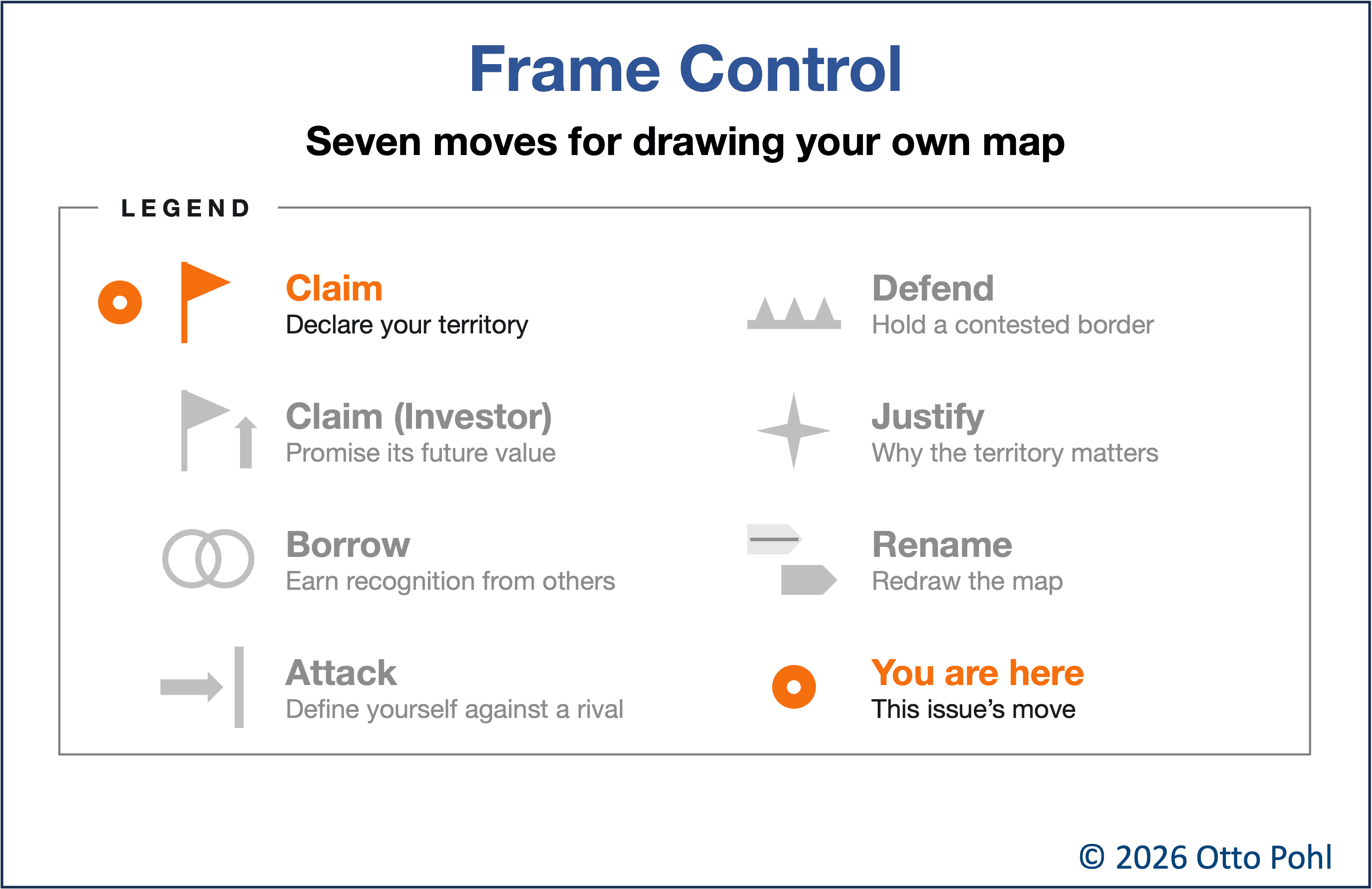
You should end up with one noun and a few modifiers. The noun is the category the world files you under. The modifiers say why you’re better than the rest of the file. The result is a spot on the map, a trailhead from which the world embarks on their journey with you.
This header and modifiers become the trailhead from which everyone embarks on their understanding of your product.
The noun comes last. Before it come two decisions most founders skip, and all three are made with the same test. Any candidate, at any step, has to answer three questions:
The Competition: Who does this put you beside? You have more say in this than you think.
The Money: Whose budget pays, and does that budget exist today? It’s a lot easier to sell into a line item than to create one.
The Objection: What’s the first skeptical question you’ll hear, and can you answer it? A good header makes buyers ask the question you answer best.
A fourth question comes at the end. Here’s the process, with TerraBlaster as the example.
Pick the problem, at the right altitude. Your technology solves a ladder of problems, noble at the top, technical at the bottom. Run each rung through the three questions. For TerraBlaster, “soil health” fails all three: the competition is everyone, the budget is nobody’s, and the first question is “what do you actually do?” “Optimize fertilizer” is a farm’s biggest input cost, but it fails the Objection at launch: nobody can answer “how much did you save me?” until a season of results is in. “Faster lab readings” is too low; it describes the solution on the lab’s terms. The rung that passes: an ag retailer’s fertilizer prescriptions are written from one soil sample every 2.5 acres, pulled by a crew it can’t staff, with results days later, when the soil changes every 80 feet. Competition: grid sampling. Money: the retailer’s sampling operation. Objection: “how do you fix that?” (Building a Pohl’s Benefit Pyramid helps here; you’ll usually land on a Level 3 benefit.) For a diagnostics founder, the same ladder runs from “earlier cancer detection” at the top to “a cheaper assay” at the bottom, and the budget line is a reimbursement code.
Plant the flag, then draw the borders. The flag is the gap: a real need no incumbent can reach, where a budget already exists. TerraBlaster’s flag is in the equipment shed. Farms already own applicators that vary fertilizer rates every 80 to 90 feet; the measurement feeding them comes from one sample per 330-foot square. The territory is the largest space around the flag that your technology enables and your competitors allow. Draw it one sentence at a time: for each competitor, write the line that puts them outside your border. Labs measure the sample you bring them, so their resolution is the sampler’s. Proxy sensors infer nutrients from a signal; TerraBlaster reads the elements in the soil. Equipment makers vary the rate; they don’t produce the map. If you can’t write that sentence for a competitor, your flag is in the wrong place. Move it.
Name it. The first two steps have already eliminated most of the nouns. Run the survivors through the three questions. For TerraBlaster, “soil sampling” wins. Competition: grid sampling and the lab, a matchup it wins on resolution and speed. Money: sampling is a line the retailer already budgets for, crew and lab fees both. Objection: “are you as good as a lab?” Yes, to within the variation between two labs.
Here’s the full Claim for TerraBlaster: TerraBlaster is soil sampling at applicator resolution. A towed unit reads nutrients directly in the soil, every 80 feet and at every inch down to six, with no cores to pull and no lab to wait on. The numbers match the lab as closely as two labs match each other, and they drop into the prescription workflow you already run.

Now the fourth test: is it true now, and truer later? The territory from step 2 should hold for the foreseeable future. The noun only has to hold for the stage you’re in. TerraBlaster’s “sampling” will strain once the sensor rides the planter and the readings drive application directly. That’s fine. When the noun shifts, you rename. When the territory fails, you have a strategy problem.
Every border excludes, and the exclusion is the price. “Soil sampling” leaves out anyone without a sampling budget. It also anchors the price: labs charge about $4 to $5 an acre, so TerraBlaster’s CEO has to compete with that (which they can). A later reposition toward farm profitability can raise the anchor. It will need a new noun, and the same territory.
Now run your own. Write your problem one rung below where it sounds noble and one rung above your solution. Write one sentence per competitor that puts them outside your border. Then write your one-liner, circle the noun, and ask the three questions. Does the territory you just drew match how you talk about your company today? If not, somebody else is doing your framing.
Share this post
Otto Pohl is a communications consultant who helps startups tell their story better. He works with deep tech, health tech, and climate tech leaders looking to create profound impact with customers, partners, and investors. He has taught entrepreneurial storytelling at USC Annenberg and at accelerators across the country.