Concepts
“It’s Nice to Have Options!” But Is It?
When leading with your platform reads as indecision
Otto Pohl
Share this post

For founders, optionality is a double-edged sword.
When you try to be all things to all potential customers (see “Niches Have Riches“), you’re handing the listener the job of figuring out which specific thing you do for them, and that’s work they won’t do.
There’s another version of this I want to discuss today. I met recently with a founder of an AI-powered materials discovery platform. He was frustrated because the cornucopia of products his process promised was leaving investors cold.
Making it worse was that the materials he can make could be used across a wide swath of industries including defense, clean tech, and oil & gas. No one industry investor felt directly addressed.
I see a lot of “platform” pitches. And positioning your company as a platform is “this is a product for everyone” in another guise. Don’t get me wrong, platforms are great, but there’s a real risk when going for early-stage funding.
Here’s how to think about it. When you pitch a platform, you’re offering a menu of maybes. But investors don’t add maybes up. They discount them.
Imagine going to your boss and saying, I have 5 decent candidates for that job vacancy. What the boss needs is one great employee, not 5 options. Optionality feels like bigness, but to the investor, it reads as indecision.
If your platform is so great, why don’t we have a specific output we can judge? Even worse, your platform isn’t a moat—or, to torture the analogy a bit, it’s not a valuable castle, so I don’t care whether there’s a moat or not.
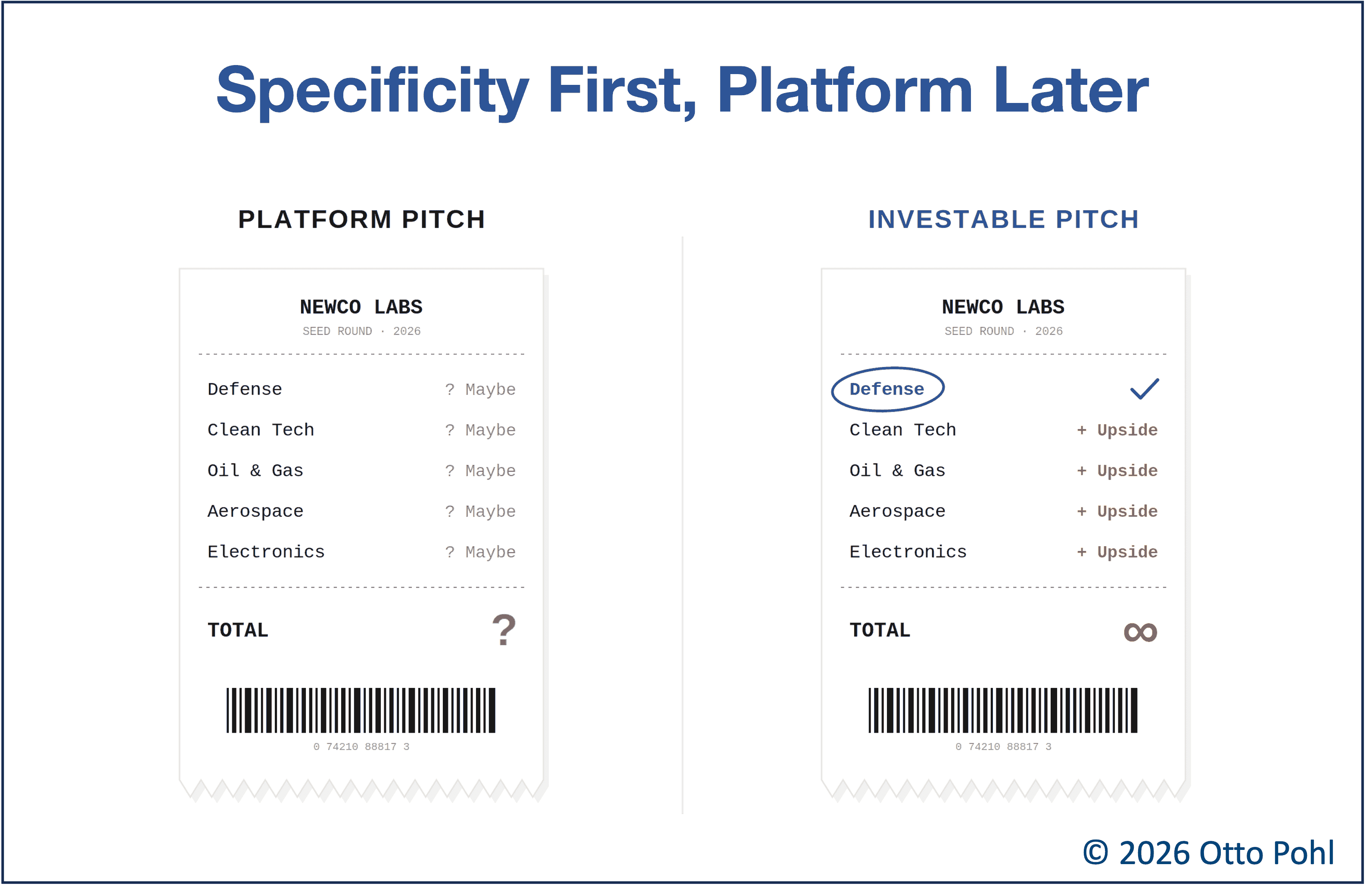
Your castle and moat is a specific molecule, device, material, or technology targeted at a defined market. It’s a specific thing an investor can evaluate.
Your story around that thing also likely includes hard-won achievements like distribution deals or pilot customers that create friction to duplicate. In a world where AI has turned software into quicksand, every bit of real-world grit you can summon makes your story, and your long-term revenue potential, stickier.
Getting specific in one market also gives you a distinctive mating call for that industry’s investors. One of the problems the materials-platform founder was having is that he’d been shape-shifting his story between AI, defense, cleantech investors for so long even he struggled to remember what his north star was.
Once you’ve made that concrete pitch, everything changes. That’s when you let investors dream about the platform you’re building. The impact of your platform story shifts from wishy-washy to sky’s-the-limit.
Once it’s built on a solid and plausible foundation, it invites investors to imagine how your value might multiply. But as in multiplication, anything times zero is zero—so you need to establish clear value first, then multiply that.
Platform: “We’ve built a discovery engine that maps targets across human biology, producing dozens of programs.”
Investable: “We’re developing this molecule for this indication. We have human validation in our sights and a clear shot at FDA approval. And by the way, the engine that found it can find the next ten.”
The first asks an investor to underwrite a method and trust that a winner falls out. The second hands them one defensible thing they can value today, with the breadth as free upside.
To be clear, platform plays do get funded. In 2020 and 2021, when money was effectively free, platform-first companies raised staggering rounds. When capital costs nothing, investors may underwrite optionality and defer the proof, and the platform’s bigness earns a premium multiple.
When capital costs something, that multiple on “maybe” collapses and only the proven path survives. And those boom-era platforms weren’t a good idea to begin with. Biotech platforms from the boom years under-delivered on exits. Cleantech has run the same boom and bust twice.
The lesson isn’t that you should hold out for the boomtimes. It’s that building durable value in any business is hard. Something like drug development is a long-cycle business, and no algorithm shortens the part where you have to find a specific molecule, prove it works in something other than a simulation, and shepherd it through a regulatory gate.
That part was always where the durable value lived. A platform pitch skips past all that messiness and asks the investor to focus on the immaculate conception of invention.
Open your deck. Does it start with a specific use case, molecule, or application, and then shift to the platform?
Share this post
Otto Pohl is a communications consultant who helps startups tell their story better. He works with deep tech, health tech, and climate tech leaders looking to create profound impact with customers, partners, and investors. He has taught entrepreneurial storytelling at USC Annenberg and at accelerators across the country.