Foundations
The Homepage Conundrum
What stakeholder group should you address at the top of your homepage? What other groups should you target? Which should you leave out? A simple framework.
Otto Pohl
Share this post

A founder once told me: “Our product is for patients, doctors, hospitals, insurance companies, and regulators.”
I asked him who the homepage should speak to.
He paused.
“Well… all of them.”
That’s the instinct almost most founders have, and it leads to homepage headlines like this:
“Transforming healthcare with AI.” Which is technically correct but emotionally meaningless.
Speak to everyone and you’ll convert no one.
To win, answer this first: Who is the hero of your homepage?
Here’s how I answer that question.
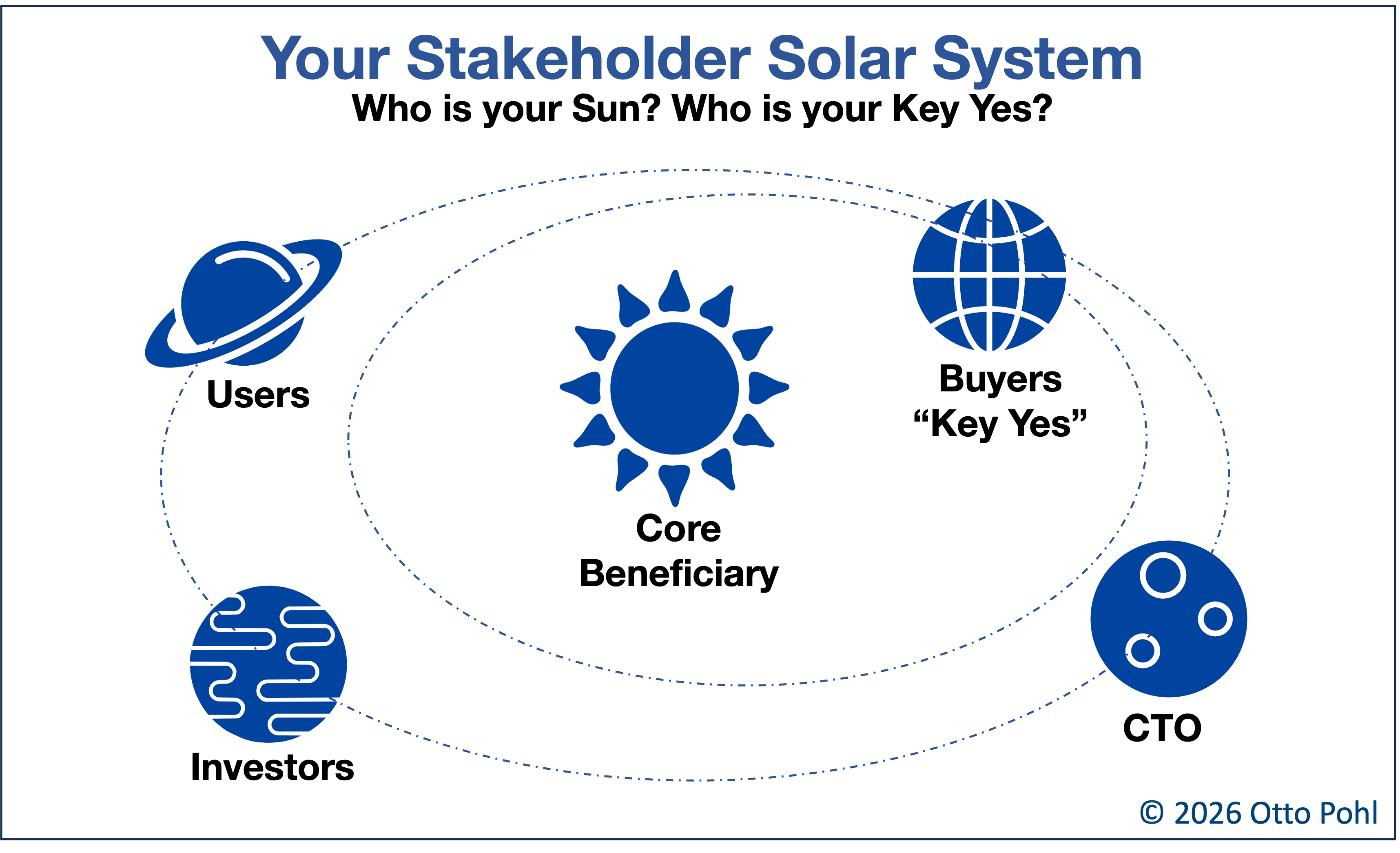
Define your solar system of stakeholders
Start by listing every group that interacts with your product. Not just buyers. Think about users, beneficiaries, influencers, implementers, regulators, and investors.
Visualize them as a solar system.
At the center is the Sun: the group whose existence makes the entire system meaningful. Remove them, and the rest collapses.
For example, consider a healthcare software company I’ve been advising. The Sun is the patient receiving improved care. Orbiting that Sun are the other stakeholders:
Clinicians
Clinic owners / CFOs
Clinic CTOs
Hospitals
Insurance companies
Regulators
Investors
Each of these groups matters. But they matter because the patient exists.
Identify the “Key Yes”
Once you’ve mapped the solar system, the question is: Which group’s “Yes” unlocks the others?
Address this Key Yes group at the top of your homepage. In the healthcare example above, the Key Yes is clinic owners or CFOs. If they say yes, the software gets purchased, implemented, and used by everyone else.
Run the traffic test
Your homepage isn’t just a narrative choice. It’s also a traffic reality. Ask three questions:
Who visits the website during the buying process?
Is the product delivered through the website?
Which stakeholders research the product during negotiations?
For the healthcare software example:
Key Yes: clinic owners / CFOs
Patients visiting the site? Essentially none
Product delivered via website? No
Other visitors during evaluation: clinicians and clinic CTOs
So the homepage hero should speak directly to clinic owners and CFOs. Further down the page—and on deeper pages—we address clinicians and technical stakeholders.
When the model changes, the messaging changes
This decision process adapts to changes in business model or company stage. In my example, the website narrative will shift if the company pivots to selling to hospitals or introduces a new patient-facing component. When they’re the industry leader, something broader might work (“The Leader in Clinical Management”).
Here are some more examples as you think through your optimal narrative framework:
Aligned business models
The simplest situation is where your Sun and your Key Yes are the same group. The person benefiting from the product is also the person paying for it. Most B2C and e-commerce companies fit into this category.
Inverted business model
Two-sided platforms are trickier. There are two solar systems, and you have to choose which one to foreground.
Usually the homepage focuses on the harder-to-acquire side of the market. Often, these companies also serve those customers via the website.
That’s why Indeed fills its homepage with job listings. Job seekers create the liquidity that makes the platform valuable—even though employers ultimately pay.
The same logic explains the homepages of LinkedIn, Facebook, and Google Search. A counterexample is supply-chain management firm Sustainment, which addresses the buyers before the contract manufacturers.
Attract the side that initiates the value flow.
Education startups
Usually, the sun is the student benefiting from the product. The Key Yes group might be the parents, the teachers, or school administrators. I worked with a startup where the student service is delivered via app but paid for by parents. The website targeted parents while the app spoke to students. Both platforms linked prominently to the other group, because both visit each.
Channel-driven businesses
Sometimes your product is sold through intermediaries. I met with a company that offers financial services to widows but distributes through financial advisors. So do you target the website to the widows (the sun) or the financial advisors (the Key Yes group)?
In this case, because the website provides direct community and support resources for widows, the hero messaging speaks to them. However, prominent subhead messaging should address financial advisors.
The same logic might apply to a medical device that targets physicians as a key sales channel but also has substantial D2C visibility.
What about investors?
Investors belong in your stakeholder solar system, but they’re usually Pluto. They don’t play a role in delivering value to the end user, so your website shouldn’t speak directly to them.
The exception is industries where your product is still years away—such as early-stage therapeutics companies. In those cases, your near-term “product” is essentially upside optionality, and investors temporarily become your Sun and Key Yes.
What’s the deal with Slack?
I’ll call this the “early big shot” approach. Their bet: the product’s value is self-evident enough out of the gate that one message (“Where work happens”) covers individual contributors, team leads, and executives alike. You see this with other big-buzz startups that feel they have the money or the momentum to jump past surgical audience targeting. Generally, it’s a risky strategy I recommend against.
The 10-Second Test
Answer three questions:
Who is the Sun of your ecosystem?
Who is the Key Yes for your current business model?
Who visits your website during the buying process?
Aside from the exceptions described above, your homepage hero should first address #2.
The Bottom Line
Startup homepages often reach for flabby language: “Revolutionizing Supply Chain Management.” But your customer isn’t “everyone.”
Your homepage needs a hero. Pick the right one, and you’ll colonize your stakeholder solar system. Pick none, and your message disappears into space.
Need help figuring out your situation? Drop me a line.
Share this post
Otto Pohl is a communications consultant who helps startups tell their story better. He works with deep tech, health tech, and climate tech leaders looking to create profound impact with customers, partners, and investors. He has taught entrepreneurial storytelling at USC Annenberg and at accelerators across the country.