Foundations
Is Your Solution a Problem?
Your company's north star might need an update. The question of framing isn’t just for pitch or sales decks. What’s the change in the world you want to see? Perhaps more pragmatically, what’s the fundamental problem a potential client wakes up and worries about, even before they know you exist? Here's how to think about it.
Otto Pohl
Share this post

My friends know my favorite movie is Wag the Dog. It’s a story about making and selling stories. It’s hilarious and sad, and genius throughout. Robert de Niro is amazing as the rumpled genius political consultant. Dustin Hoffman is the perfect imperious movie producer. Filmed during the Clinton years, the themes have only become more relevant in today’s politics.
I am working with a startup that realized they’ve outgrown the problem their startup was created to solve. That’s just like in the movie, where Hoffman realizes that the fake war they created has been shut down by the CIA. “Now we really do need an act 2,” Hoffman says, and directs Willy Nelson to write a new theme song—“a ballad about loss and redemption.”
The startup was founded to optimize data center energy usage. They’ve been quite successful, both in increasing energy efficiency as well as in gaining traction among customers.
The challenge is that, as one of the founders puts it, “we’re solving priority #5 for these companies.” Energy efficiency is meaningful but not trajectory-changing. “What management really cares about is growth and operational stability.”
They are expanding their product to address several of these issues. And as we talked about the challenges of running a data center business, it became clear that there was an opportunity to reframe the company’s mission to more directly address the client’s top concerns.
So instead of diving straight into specific issues their platform solves, we first frame the company as a partner in the quest for reliable growth and corporate success: "We eliminate operational complexity so you can grow without hiring."
In other words, we address your most fundamental business concern. Under this umbrella energy efficiency retains a spotlight, but it’s positioned (along with several other new services) as a tool to solve a higher-level customer need.
The question of framing isn’t just for pitch or sales decks. This is about the north star of your company. What’s the change in the world you want to see? Perhaps more pragmatically, what’s the fundamental problem a potential client wakes up and worries about, even before they know you exist?
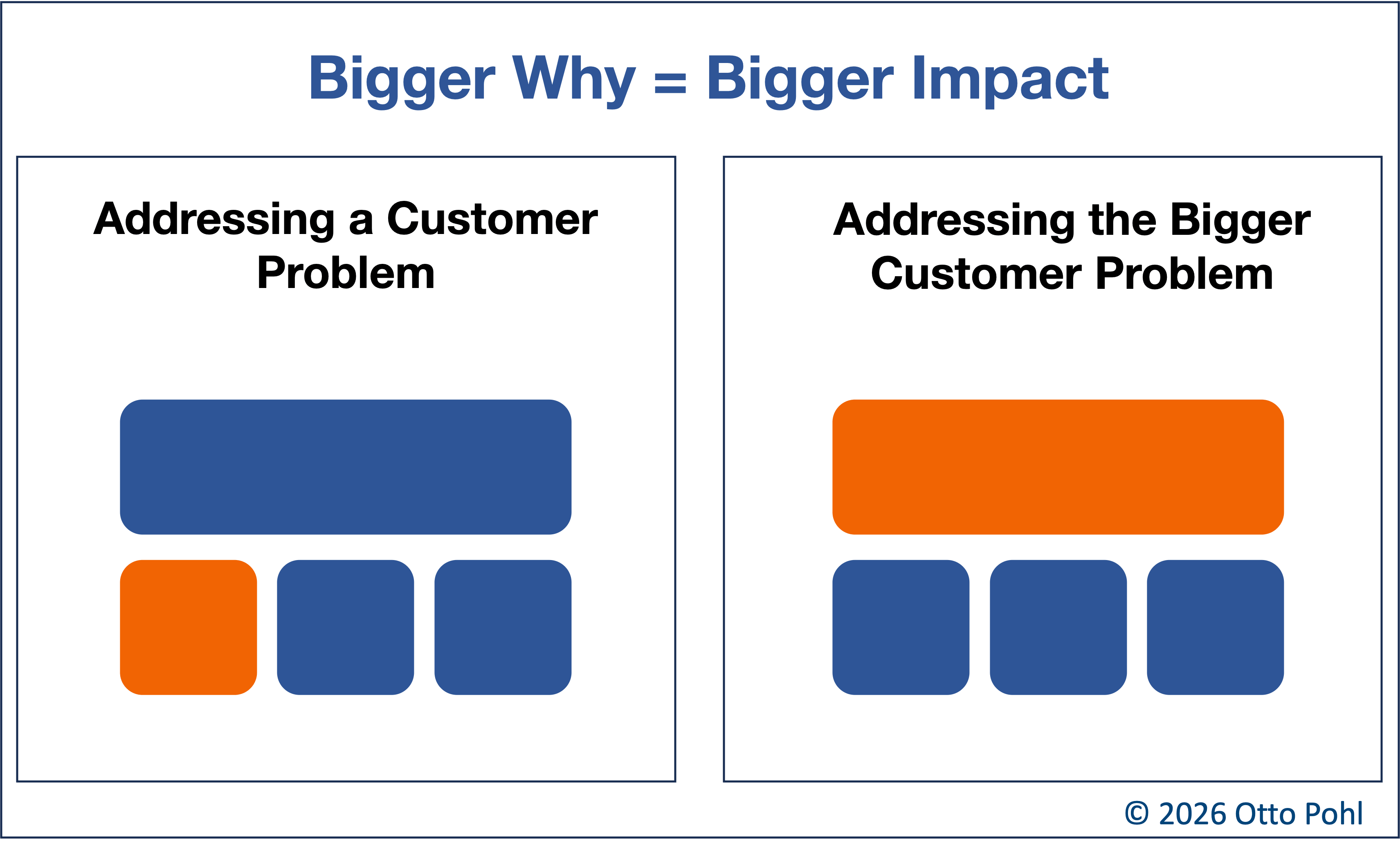
I’ve seen a good number of startups who need this sort of narrative molt. It’s often triggered by product or feature expansion, but also from the realization that there’s a bigger problem that you solve for customers. Its articulation answers a higher-level Why.
I worked with an HR tech company that had built a sophisticated tool for tracking compliance training completion. The problem was that the person who cared about compliance sat three levels below the person with the budget. When we reframed their pitch around workforce readiness and reducing legal exposure at the board level, they suddenly had something a CFO wanted to hear.
Then there was the supply chain startup whose original pitch was built around reducing supplier onboarding time — viable, but not a hair-on-fire problem. When tariff volatility started hitting clients, the team realized they were positioned to help clients understand the condition of their global supply chain. We shifted the story from “faster onboarding” to “we're your early warning system when the global trade map redraws itself.”
It’s analogous to retail companies with names they ultimately found constrictive. Dunkin' Donuts quietly dropped the “Donuts” because the word was limiting who walked in the door. Weight Watchers rebranded as WW to shake the idea that they were just about dieting.
Think of the art on your wall: The frame is an integral element. Upgrade the frame and the same painting looks better.
It’s the same thing here. So ask yourself, is your problem a problem? Let me know if you’d like to brainstorm.
PS I know founders have 99 problems and watching more movies ain’t one. So let me leave you with just one other theme from Wag the Dog, one that always made me feel better as I navigated the travails of startup life. Whenever a problem arises in the movie, Hoffman waves it away with the refrain “This is nothing!” And follows it with a description of ridiculous scrapes he escaped over his career, like “Try a 10am script meeting, coked to the gills, no sleep and you haven't even read the treatment!”
Ok I’ll stop now with the quotes. Watch the movie.
Share this post
Otto Pohl is a communications consultant who helps startups tell their story better. He works with deep tech, health tech, and climate tech leaders looking to create profound impact with customers, partners, and investors. He has taught entrepreneurial storytelling at USC Annenberg and at accelerators across the country.