Practical
Your Website Isn’t a Billboard. It’s a Background Check.
I see a lot of startup websites that focus on the bold and the dazzle. Better is to make yourself look big and reassuring. Before you rewrite your website, use this framework to identify key issues and how to resolve them.
Otto Pohl
Share this post

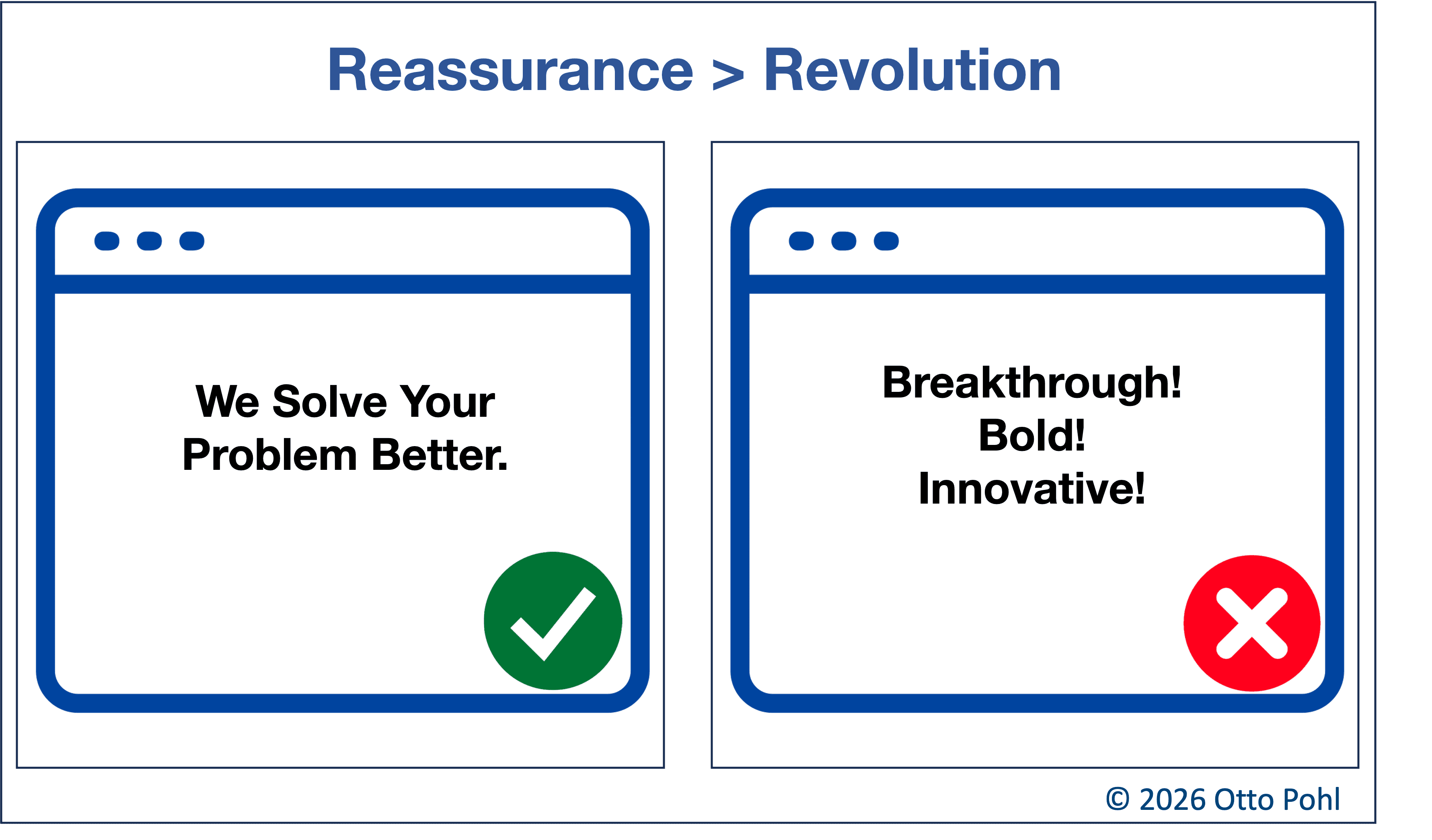
I’ve been working on a website for a client that builds secure AI for companies in regulated industries. It crystallized a thought I’ve had for a long time: Your website should reassure first—and differentiate second.
That ordering matters more than most founders realize.
It’s tempting to lead with what’s revolutionary and unique. That’s what you pitch to investors, after all. But if you’re a B2B, deep-tech, non-mass-consumer startup, most of your website visitors are not strangers. They didn’t stumble across your site while wandering around the internet.
They arrived because you spoke with them, a colleague mentioned you, or they heard about you on a podcast.
In other words, they’re warm leads. They’re not browsing, they’re doing due diligence.
Many startup sites focus on the dramatic sell: the hero headline is clever, not clarifying. The copy and design lean hard on mystique. There might even be a certain insecure posturing, as if putting the word “revolutionary” in a large enough font will make it true.
Overall, there’s more focus on ambition than safety. And that’s a problem—because buying decisions aren’t blocked by lack of excitement, they’re blocked by doubt.
The SEO trap
Founders often ask me about SEO. For most B2B startups, that’s the wrong default mindset.
Your best leads are rarely cold. Even if someone clicks a paid ad, they do so because they already recognize the problem you’re describing. They’ve self-selected.
So when they hit your site, your job isn’t awareness—it’s buyer enablement.
That means leading with security, reliability, compatibility, and outcomes. Channel a subtle version of “no one ever got fired for buying IBM.” Yes, you are different. Maybe even revolutionary. But first, you must be safe.
Build a reassurance inventory
The fastest way to improve your website isn’t by brainstorming a list of clever taglines. It’s by listening to your sales calls: What objections come up repeatedly? What questions stall momentum? Where do deals quietly die?
The arguments you use to overcome those objections should be featured on your site.
Investor pitches work the same way
I help founders review their investor call recordings for post-game pitch coaching, and I see the same dynamic. I’ll write a full piece someday on investor-call optimization, but here’s the relevant insight for today’s topic: The calls that go best are the ones where the investor already believes the core thesis.
Before you call me Captain Obvious, think about most pitch decks (maybe even yours): They are usually preaching to the unconvinced. That’s not wrong. But when you realize you’re speaking with someone who already buys the story, your job pivots to reassurance. Emphasize traction, unfair advantages, and credible go-to-market plans. It’s also why I always encourage founders to meet with investors live instead of emailing decks—that lets you read the room and adjust.
What about the vision & big picture?
My clients know I care deeply about framing their startup in big terms: why it matters, why it’s a game-changer, why the world needs it to succeed.
That work is essential.
But on your website, it’s usually best handled with a show-don’t-tell approach—surfacing the vision implicitly through clarity, confidence, and proof. Save the explicit “why we exist” narrative for your About page.
(The one exception are startups that are still years from having a saleable product— common in life sciences and long-horizon deep tech. In this case, the audience for your website is investors, so leading with the big picture on the home page makes sense.)
A quick reassurance audit
Pull up your website, channel your Ideal Customer Profile, and ask these six questions:
Is this company a legitimate category player? Do they prioritize security, support standard integrations, comply with regulations, and show recognizable customers?
Is it for someone like me? Do they speak to my role, my industry, and my constraints? Do the case studies feel relevant?
Will it work in my environment? Is the implementation path clear? Are integrations, data flows, and security or regulatory FAQs easy to find and reassuring?
What happens after I click “Book demo” or “Start trial”? Do I understand onboarding, what’s required from me, and how long it takes to see value?
Can I trust this company with my career? What’s the risk I’ll get fired for working with you? Is there enough third-party validation, great social proof, and self-aware talk of limitations?
Can I justify this internally? What’s the ROI, is the pricing clear, can I send the site URL to colleagues without scaring them?
If your site can’t answer these cleanly, your sales team is doing unnecessary work. Review everything a lead might see with a quick Google search—LinkedIn, Medium posts, X/Twitter, podcasts—and ask the same questions.
The quiet truth
Your website is part of your sales team—and I mean that literally. That great lead you just spoke with on the phone? The moment she hangs up, she goes to your site to test her resolve.
People who are inclined to buy are actively looking for reasons not to.
Differentiation matters. But differentiation can increase perceived risk.
So reassure first.
Then differentiate.
Share this post
Otto Pohl is a communications consultant who helps startups tell their story better. He works with deep tech, health tech, and climate tech leaders looking to create profound impact with customers, partners, and investors. He has taught entrepreneurial storytelling at USC Annenberg and at accelerators across the country.